
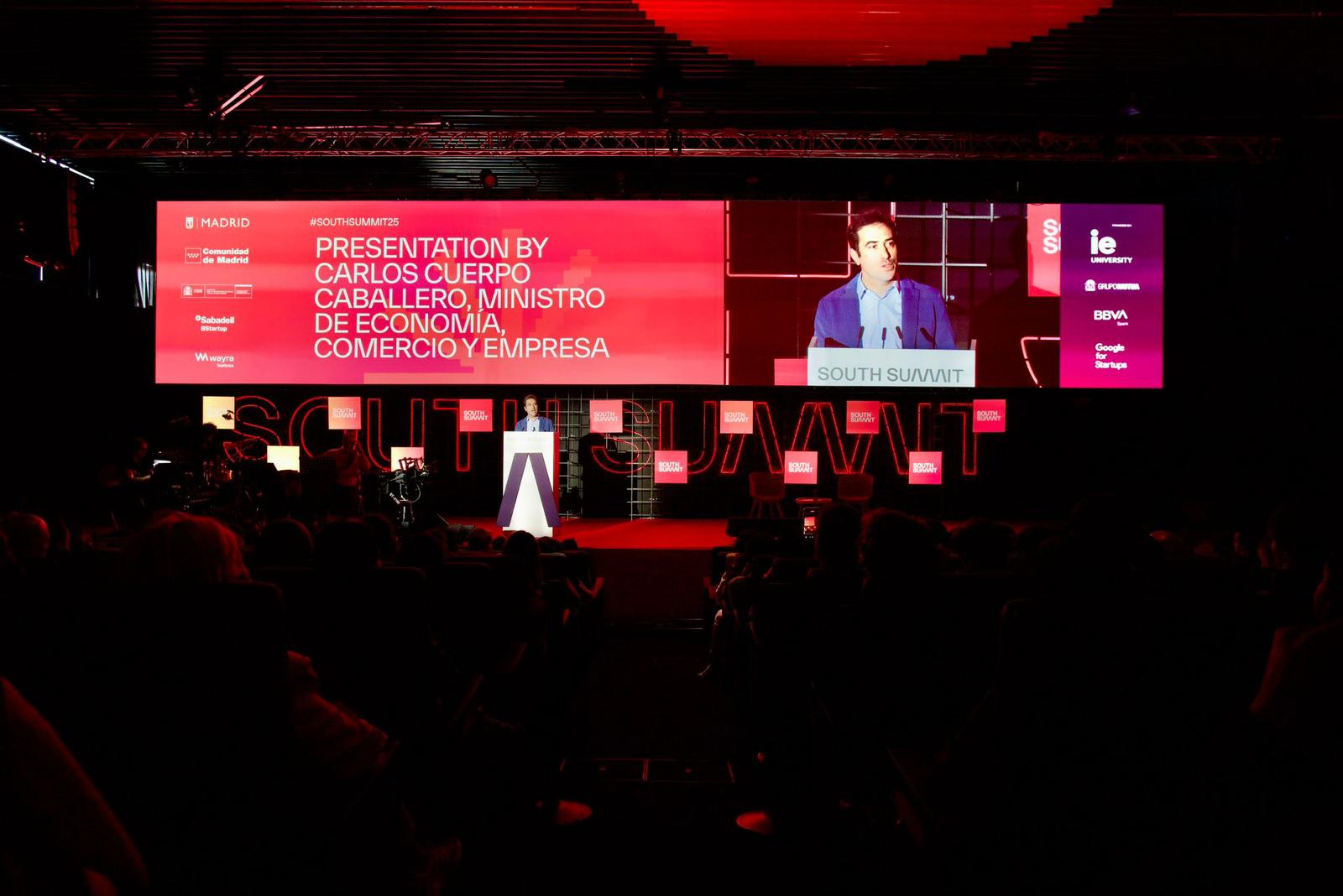
Intervención South Summit 2025
Dear friends, startups, investors, companies.
As we were just discussing, the summit is increasing in quality, in its impact, so we're all very happy about that, Maria. You are a true visionary. When you started, when you created the South Summit more than ten years ago, it was a pivotal moment, very complicated for the economy, for Spain in particular as well, and you wanted to show the world the Spanish potential and talent, and we're still there. We're still showing the world. We've come a long way, Maria, but as the motto says, we're most definitely in motion, we're still moving.
And it's unfortunately also a very complicated moment, nowadays, for the world economy. Significant uncertainties make it increasingly difficult to plan investments or also confidently manage operations. But I am an optimist by nature, as you said, Maria. I think we both have that in common, and I'm confident that Europe and Spain will be able to transform uncertainties into opportunities. And that's actually the very essence of entrepreneurship, turning challenges into business opportunities, so please bear with me for a short while while I explain why I think there are reasons for optimism.
First, when we look at the momentum for Spain, there are many reasons to be optimistic. According to official forecasts, Spain will once again, in 2025, lead economic growth among the major developed economies.
Even under this very complex geoeconomic landscape, the Spanish economy has shown remarkable resilience. Our GDP grew by 3.2% in 2024, almost four times the Eurozone figure. We represent around 10% in terms of the size of the Eurozone, but we contributed by 50% to Eurozone growth last year.
But it's not just about growth, it's also about how we grow. Unlike in the past, we grow in a sustainable and balanced way. Employment and productivity go hand in hand. Inflation is increasingly under control. And the external sector enjoys record numbers out of hugely competitive firms in Spain.
This good momentum comes with also promising figures on the entrepreneurship side as well. Spain has the second fastest-growing technology entrepreneurship ecosystem in Europe between 2019 and 2024, with an economic value that has multiplied by 2.7. Due to collective efforts, such as the Start-Up Law, it is already a consolidated ecosystem, with more than 8,000 active tech startups and more than 13 billion invested in Spanish startups between 2021 and 2025. These are huge figures.
In the first quarter of 2025, more than 1.1 billion was invested in Spain, 80% more than one year before. This confirms also a very good upward trend. In 2024, more than 3.1 billion was reached, 30% more than in the whole of 2023.
So, the first reason for optimism is the great outlook.
The second reason for optimism is the success story, as I said before, of our external sector. It's a great dynamism coming from our exports, goods but also specialist services, but also the capacity to attract foreign investment.
Spain is becoming a hub for foreign direct investment. According to the OECD, Spain is the third country among G20 countries with the highest stock of foreign investment as a percentage of GDP, only after the UK and Canada. The Financial Times database actually ranks Spain as the fifth largest recipient of greenfield projects globally between 2018 and 2024. The second when we focus on investment in renewables, and the fourth when we focus on R&D and AI-related projects. These are critical projects that involve new infrastructure, equipment, logistics, human capital, employment with very positive spillover effects. This all provides an excellent background to continue to boost dynamism and productivity in the Spanish entrepreneurial system.
Early in March, I had the opportunity to meet with different agents from this ecosystem in Barcelona, and I was very happy to witness firsthand the great momentum that is leading Spain. But I also took good note of the remaining challenges that must overcome. We must do it together, of course.
The main challenge, as we all know, is scalability. It's an absolute priority for the Spanish government, and allow me to be very specific. We need scalability and better access to finance and dynamics. In this case, we need also solutions that are tailor-made for each type of company.
If we consider the number of startups in Spain, I think we can agree that our Startup Law was key to inject as I said before, dynamism into the sector. It was also a great example of what we can do when we collaborate together with the public and the private sector, including also the different levels of administration.
However, when you look at the total level of the number of startups, it represents 7% of the total number of startups in the EU, but we only account for 3% of the EU scalers. So there's a lot of room for us to grow there. In the EU, also when we look at VC [venture capital] investment funds of more than 1 billion there are only 11, while in the US we have 135.
So we need more funding to be made available for our startups and scalers to grow. Since we met in March, therefore, through different teams from the Ministry, the Treasury, ICO as well, ICEX, have been working in continuous contact with the sector to be able to put forward solutions that promote scalability of our ecosystem.
Let me be very brief on a few ideas that we've been working on. Four work streams that I would like to share with you today. Try to address the different dimensions that are at stake here.
- So first, we're trying to lead the way at the
EU level to have a more agile EU governance. We know, as professors Draghi and Letta confirmed in their report, that the size of the European single market of 450 million consumers provides a huge and unparalleled potential for growth and competitiveness. But we need swift decision making. That's not always our strength at the
EU. For years, this has actually blocked progress towards more integrated capital markets amongst other projects, hampering financial possibilities for our businesses. This is why I'm very proud to say that Spain is leading an initiative that we call the European Competitiveness Lab, which is another governance tool that reconciles innovation with integration. It provides a bottom-up approach building on a few countries' willingness, coalitions of the willing, to implement new initiatives that will be assessed and therefore afterwards scaled up to the rest of the
EU member states.
Tomorrow, I will actually be travelling to Paris and will be showcasing our first project of the Lab, a Pan-European Savings Label, that should unlock detailed savings for investments within the EU. More will follow, one project at a time of course, but we are generating a new inertia and that's a key factor going forward.
- The second work stream is, of course, availability of resources. Significant efforts, as you all know, have been made with the Next Generation EU funds by making about 8 billion available for entrepreneurship through a different series of funds -ICO, AXIS, FOCO, ENISA…- a bunch of acronyms, but you'll see my point, 8 billion available. We're going to do now an exercise to strengthen the coordination of the execution of the implementation of those funds. When you look at the US, for example, 72% of innovation funding comes from institutional investors. In Europe, only 30%. There is room, again, there for improvement and we want to take advantage of this possibility of generating further coordination amongst the different institutions and investors. Actually, ICEX is establishing a working group in which all of these relevant stakeholders will participate, and to which all identified Spanish startup investment projects will be brought for information. Like a one stop shop in a sense, that will increase the efficiency of the use of public funds and will also facilitate access to public funding for startups. It's also essential to have foreign investment to co-invest the Spanish public and private capital because it's actually a must that we have, that we still need to keep on attracting investment. As we were just discussing with Maria, it's not just about what we can do in Spain, it's about how much we can also attract to invest in Spain and in Spanish companies. This is why Invest in Spain has been working intensively on a strategy to attract investors by organizing missions with Spanish funds to key international VC markets such as Singapore, Mexico, or Colombia.
- Third work stream, and I'm getting to the end. Of course, projection on the international stage. It's key, not only to facilitate access of startups and scale-ups to more funding, but also to more customers. I'm a staunch believer in your value-added and you can count on me to highlight the value of Spanish entrepreneurship in the world. We're already preparing for a roadshow in the second half of the year in key markets for Spanish entrepreneurship, such as London, Canada, or Berlin, amongst others. As of September, a new program will be in place to broaden the ecosystem of firms that incorporate open innovation. Additionally, we will be leading by example. Also, ICEX, of course, will be joining the Spanish open innovation ecosystem as a venture builder to help solve challenges posed by internationalization through technology and entrepreneurship.
- This is the fourth work stream. First pilot project bringing them all together is a pilot project in the biotechnology sector. We're starting in Boston, where ICEX team will travel in 10 days with a specific proposal to seek U.S. funding and client's interest in the quality of Spanish projects in this field. We'll gather feedback, learn and replicate or scale-up also for other sectors, such as deep science or space, amongst others.
Let me conclude, because I think our ideas are pretty clear. Undoubtedly, we are living in a good moment for our ecosystem, but the big question for us is how can we consolidate these good figures and ensure that the momentum is driven forward.
This is actually what keeps us busy every day. I mentioned the Draghi and Letta report already. They talk about financial resources, agile governance in our institutions and also the need for businesses to grow as a key element for productivity, competitiveness and ultimately also strategic autonomy, which actually centers, including economic security, every debate nowadays.
But just in line with the South Summit motto, “In motion", we need businesses to grow, as I said, to thrive, to go off-road, to keep moving forward.
So my message on behalf of the Spanish government is very clear. Full support on this quest for growth.
Of course, we are partners in this and we are committed to do our share to strengthen the ecosystem. With public policies that will keep on accompanying your talent and turn it into real opportunities for growth, employment and social cohesion.
So let's keep up this good work and let's enjoy working together.
Thank you very much.
Transcripción realizada por el Departamento de Comunicación del Ministerio de Economía, Comercio y Empresa